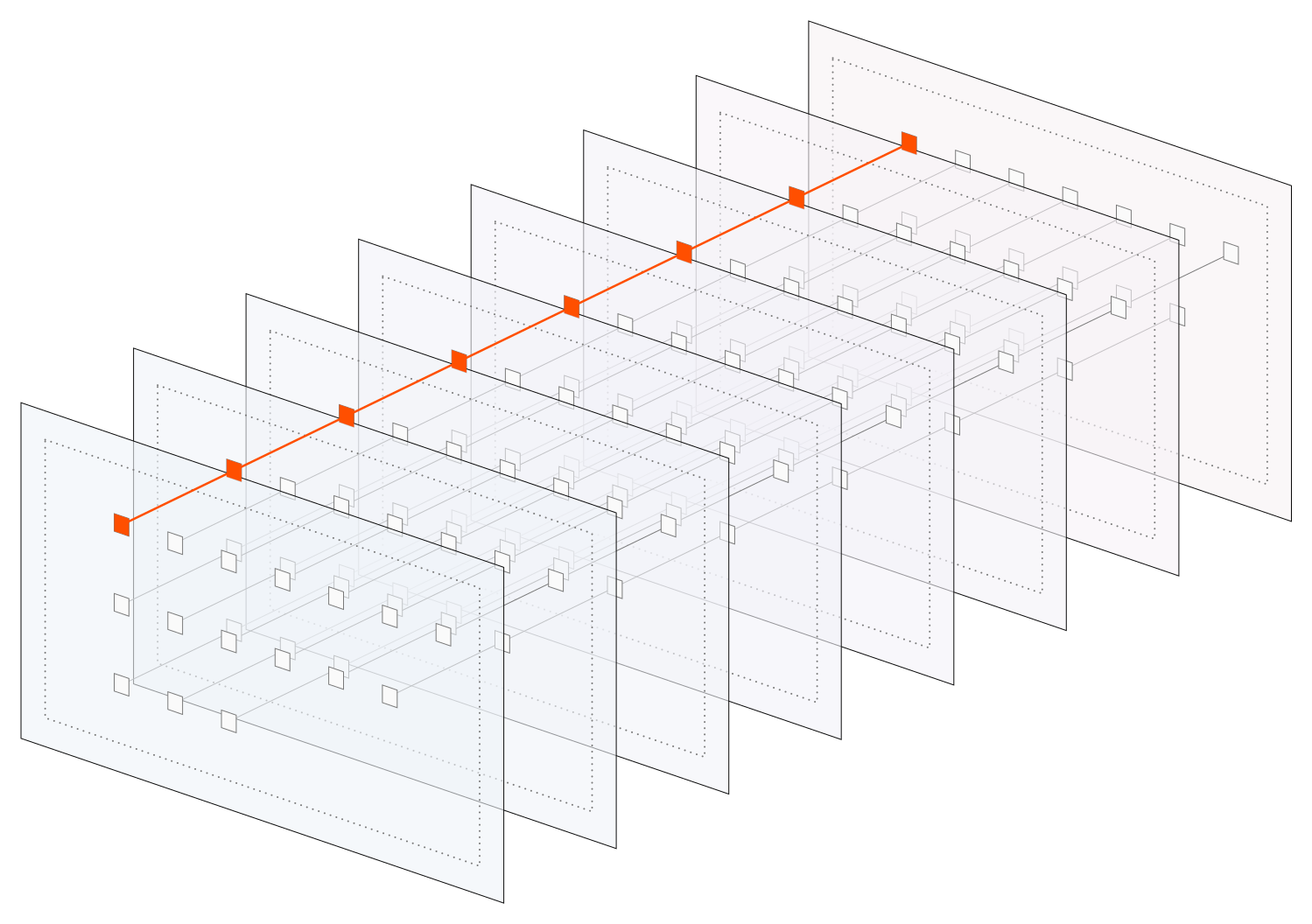
The lanes group the lines under audit, management and protection.
Audit
One list shows every system that holds your data and who has access to each.
Logs, telemetry and AI prompt stores come under this review.
Models and tools in use each get an entry that says what the tool is for and what data it works on.
A bank, a regulator or a counterparty can read the pack from this review of your data-handling, AI-use and security practices.
Where a regulator publishes a rule set, the check runs your data against it and reports what passes and what fails.
This review examines how you collect, clean, store and destroy sensor and video data.
The result states whether your main database sits in the country and, if it does not, what has to change.
Management
Once integration joins your systems, data moves between them without manual transfer, and data quality is part of the work.
Schemas and fields from each of your source systems go into one catalog.
A regulation becomes article-level requirements, then product requirements and an evidence pack.
Policies name an owner for every data set and every AI tool, and a roadmap puts the gaps in order of risk.
The application gains an audit trail it cannot rewrite, accuracy measured on a schedule and refusal to answer on weak evidence.
Retention runs in tiers such as immediate deletion or legal hold, and the scheme holds when an auditor asks to see it.
Protection
Access separation and a baseline level of information security come out of this work.
Redaction comes before logging, untrusted input goes to quarantine, and limits apply to what an agent may call.
Security operations teams get playbooks, detection rules, threat hunting and incident investigation.
Sectors
The same inventory questions apply in every sector
Cases
Regulatory program delivery
A commerce platform passed its privacy audit and launched on schedule
Situation
A new commerce platform reached its pre-launch review, and legal withheld sign-off. That blocked the whole multi-market rollout.
Work
The program broke the regulation into article-level requirements before engineering estimated the work. It closed the platform's gaps with anonymization at the data layer, back-office tooling for data-subject requests and a self-service privacy route for customers. Legal, business operations and engineering agreed the minimum launch scope together.
Result
The audit returned no critical findings, and legal signed off. The program delivered the full scope in the first update after launch.
Online sales continued while a retail platform met a second privacy law
Situation
A global retail platform that used the GDPR as its baseline came into the scope of China's Personal Information Protection Law. The law set a fixed effective date, and missing it meant suspending online sales in that market.
Work
An applicability assessment and a map of the platform's data flows came first. The program then designed transfer and storage for that market and reworked consent and notices against the statute, because the implementing rules were not final.
Result
The online sales channel operated without interruption through the effective date.
AI governance evidence
An AI knowledge platform reached production with a ledger of every agent call
Situation
An AI platform answered staff questions from an organization's own knowledge, and it opened the same knowledge to external AI agents.
Work
The platform writes every agent call to an append-only ledger. The database denies the application any right to change or delete an entry. When its sources do not support an answer, the platform says it does not know and passes the question to the person who owns that area. Simulated users put questions to the platform, a judge model scores the answers against a rubric, and every regression becomes a repeatable test.
Result
The platform went from pilot to production, and its ledger recorded every agent call.
Incident response and detection
All shifts at a security provider adopted the same ransomware playbook
Situation
Analysts at a managed security provider handled ransomware incidents differently from shift to shift.
Work
The playbook covers detection and triage, containment, eradication, recovery and the review after an incident. It sets the roles and the escalation paths, lays out decision trees for containment and eradication, and gives analysts step-by-step procedures.
Result
The provider's responses to ransomware no longer differed between shifts.